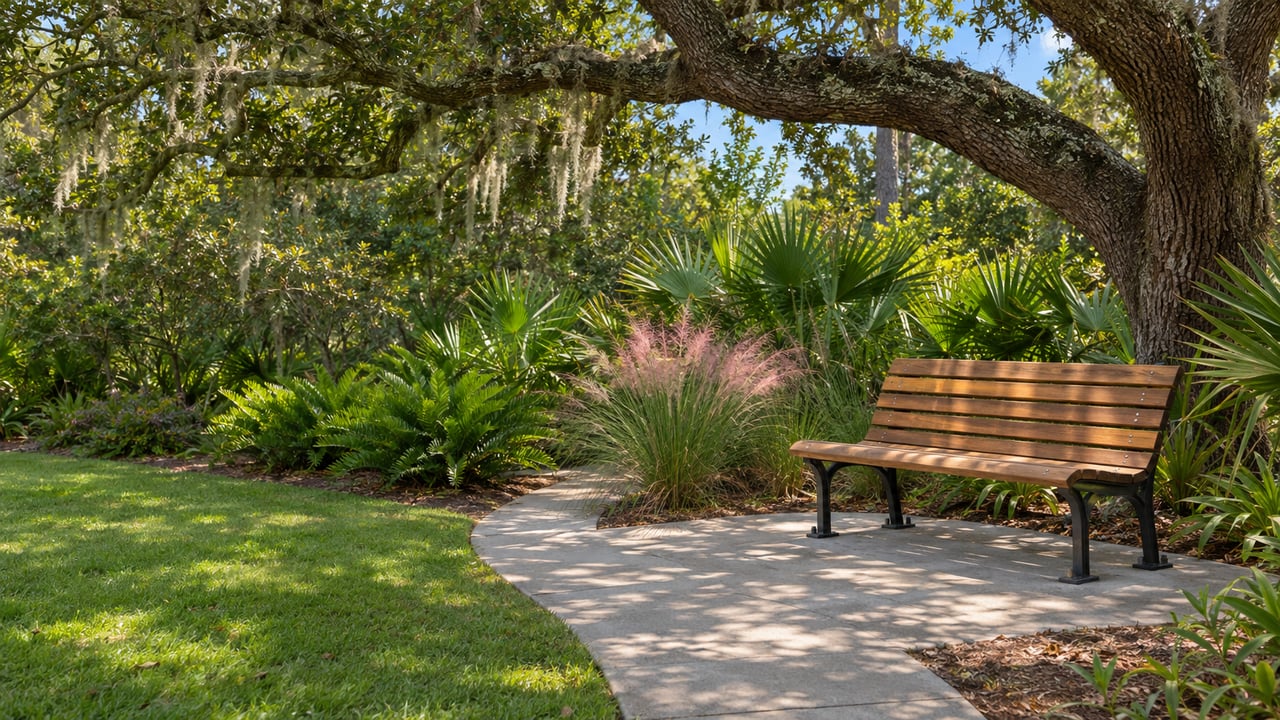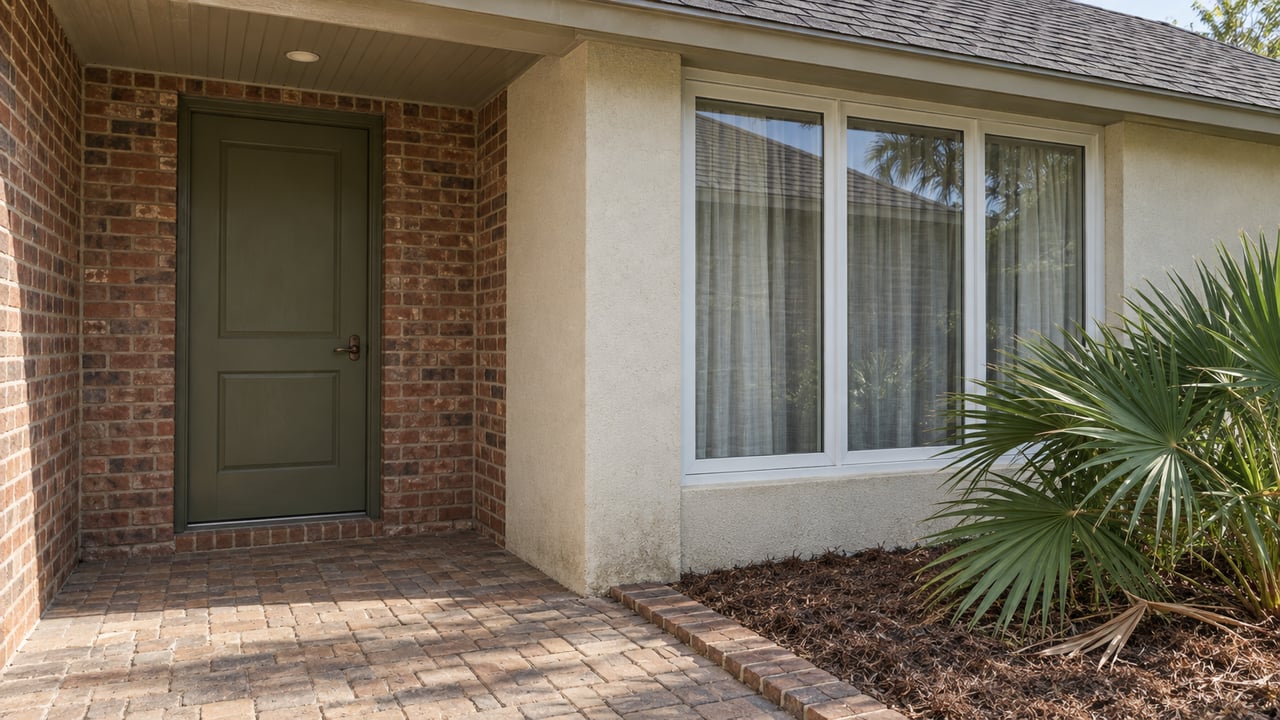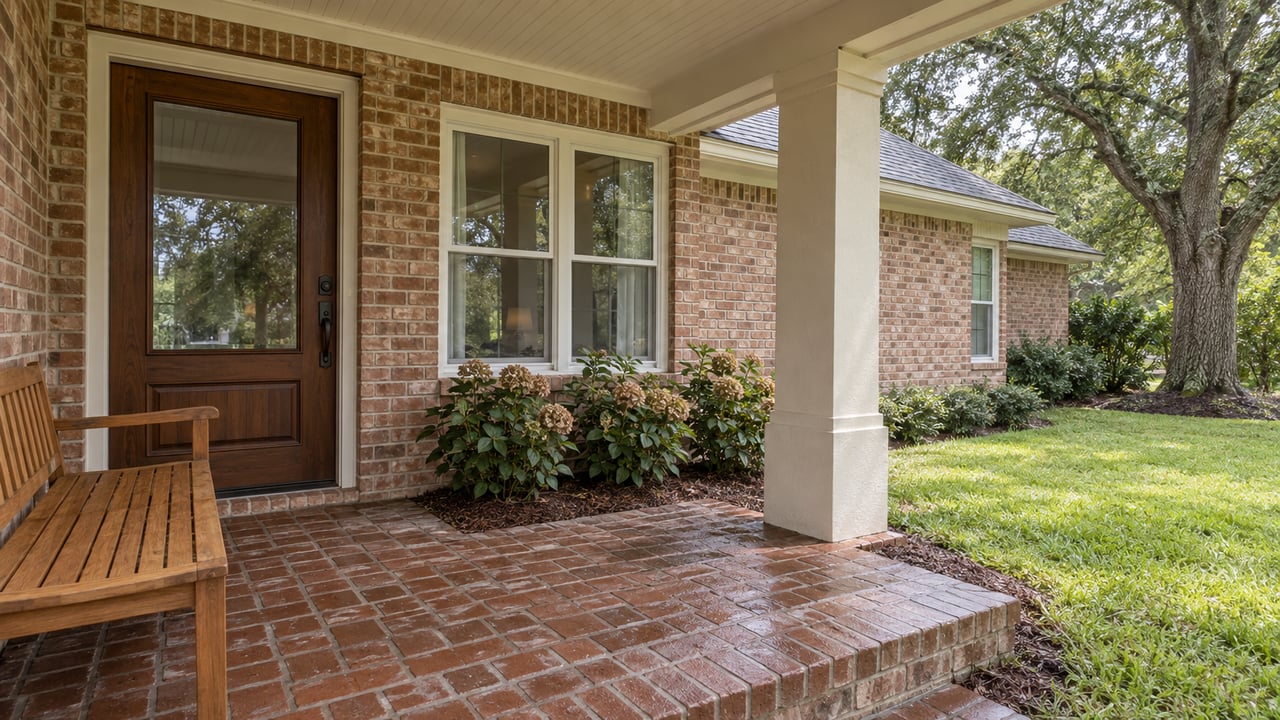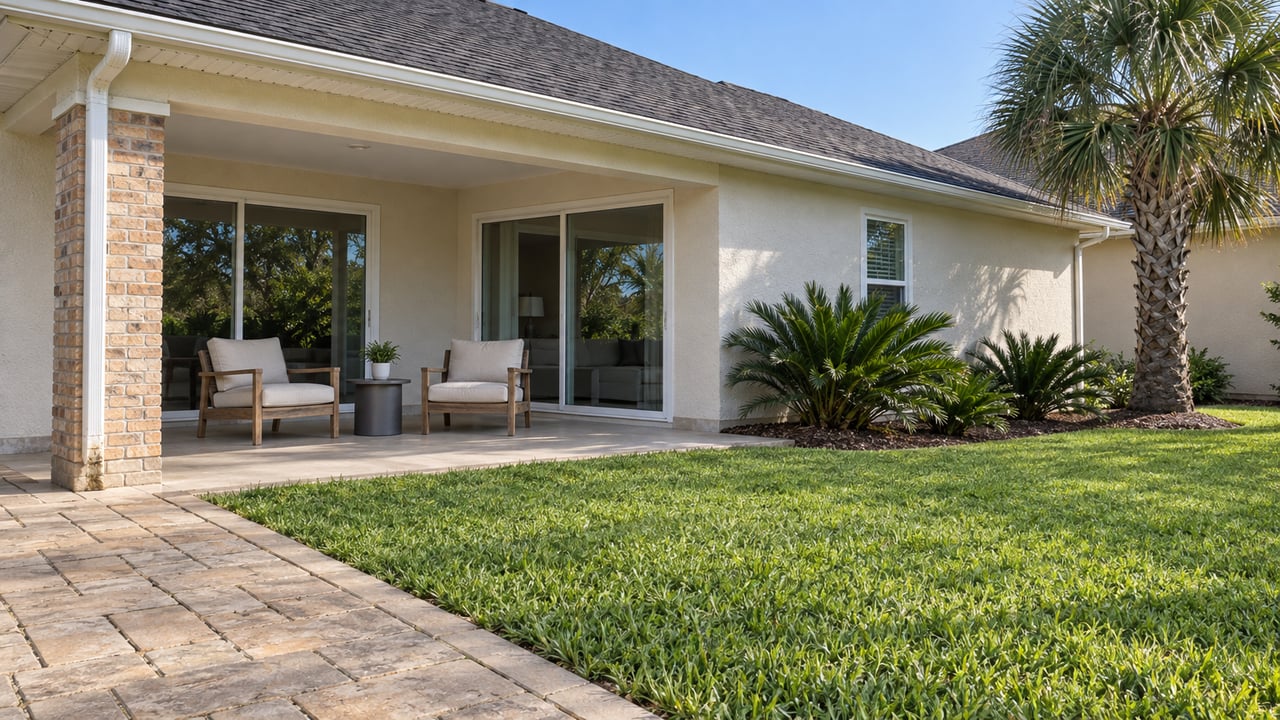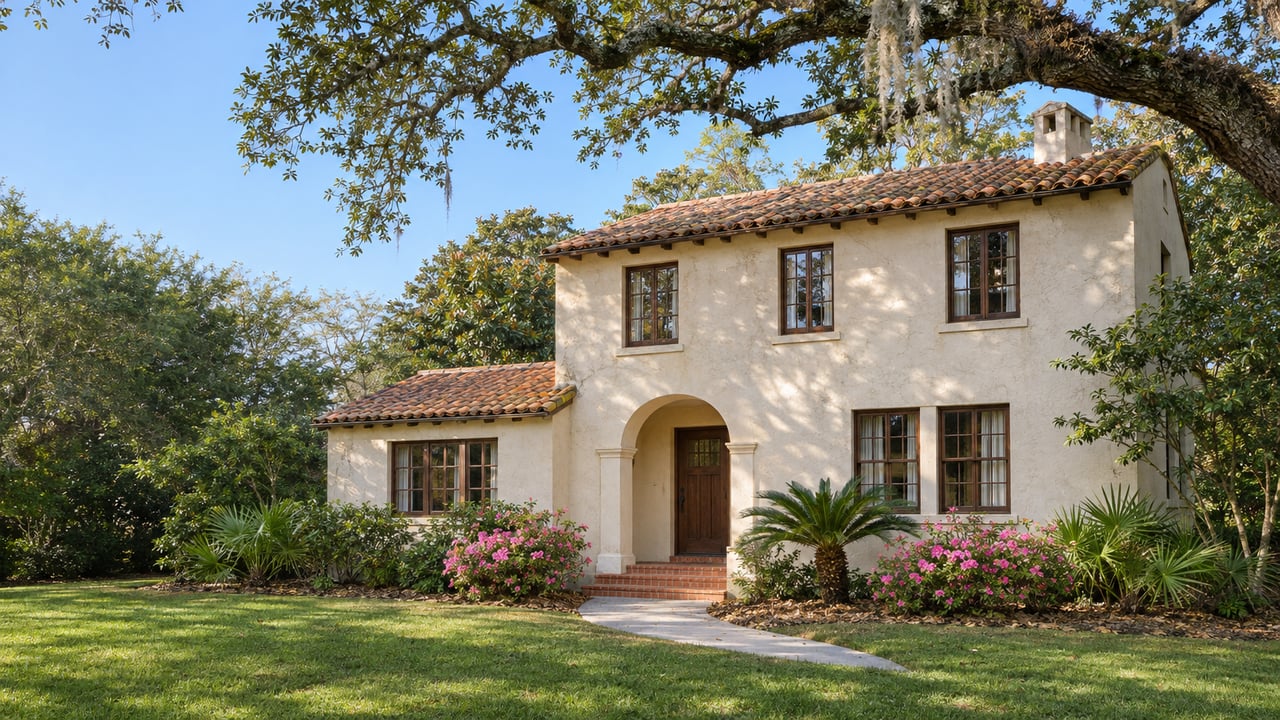
On Via de la Reina, 3609 is one of the Mediterranean Revival houses the San Jose Estates Company built during the Florida land boom, and its address is on the National Register inventory. Its neighbor at 3615, a 1975 house with 2,970 square feet, was listed in mid-November at $699,000. The two houses are about fifty years apart in age, and a buyer driving down the street can tell which era each one comes from.
That pattern repeats across San Jose. The original houses look like a separate market, with their own architects, a National Register listing and a 1920s back story. On a price-per-square-foot basis, though, their sales land inside the same range as the ranch houses built around them after the war. Most of what you pay for a 1920s San Jose house is its size.
A Planned Suburb That Stopped at Thirty Houses
The San Jose Estates Company was formed in 1925 under Charles W. Strickland. It bought about 1,000 acres and hired planner John Nolen to lay out a self-contained suburb. Marsh & Saxelbye designed the buildings in the Mediterranean Revival style, and O.P. Woodcock's firm was the general contractor. When the boom ended in 1926, the development had thirty private houses, three public buildings and four gatehouses. The company built no more homes after that. By the time preservationists surveyed the area for the National Register nomination, nine of the thirty houses were gone.
The rest of today's San Jose came later. In 1947, Stockton, Whatley and Davin bought the company's unsold property and started building postwar houses on the empty lots. The infill went so deep that the nomination listed the survivors as a 24-building "San Jose Thematic Group" and not as a historic district. Too many newer houses sat between the originals for a district boundary to make sense.
You can still trace the original plan through its public buildings. The former San Jose Hotel at 7400 San Jose Boulevard is now part of The Bolles School campus. The building at 7423 San Jose Boulevard, which the nomination lists as the San Jose Administration Building, is home to San Jose Episcopal Church. The last gatehouse stands at 1873 Christopher Point Road North at San Jose Boulevard. The 1985 nomination expected it to be moved, but it stayed on its original site and was listed on the National Register in December 1988. San Jose Country Club dates its Donald Ross course to 1925, and its current clubhouse was finished in 1947. Marsh & Saxelbye also designed Epping Forest for Alfred and Jessie Ball duPont in 1927. The Resident Community News told that estate's history in May 2026, including du Pont's purchase of the land from the San Jose Estates Company.
Today the original houses are a small minority. One MLS-based count of the core San Jose streets finds about 594 homes, built between 1925 and 2016, with a median build year of 1960. On Via de la Reina, six homes date from the 1920s and 32 from the 1950s. Madrid Avenue has a single 1920s house against 24 from the 1950s and 19 from the 1960s.
The Same Streets, Priced by the Foot
The table below lists the most recent recorded sale of the original houses that have traded since 2021, next to postwar sales on the same streets. The 1920s sales are older because these houses seldom change hands. Treat them as their last recorded prices, not as what they would bring today.
| Address | Built | Sold | Date | Sq ft | Per sq ft |
|---|---|---|---|---|---|
| 7144 Madrid Ave | 1925 | $950,000 | Jul 2022 | 3,754 | about $253 |
| 7122 Madrid Ave | 1948 | $545,000 | Jul 2025 | 2,324 | about $235 |
| 6963 Madrid Ave | 1965 | $474,500 | Sep 2026 | 2,964 | about $160 |
| 3500 Via de la Reina | 1925 | $925,000 | May 2021 | 4,111 | about $225 |
| 3904 Via de la Reina | 1957 | $290,000 | Jul 2025 | 1,448 | about $200 |
| 3721 Via de la Reina | 1956 | $342,000 | Nov 2026 | 1,900 | about $180 |
| 3759 Via de la Reina | 1956 | $243,000 | Sep 2025 | 2,043 | about $119 |
The two original houses sold for anywhere from about 1.7 to nearly four times as much as their postwar neighbors. Divided by square footage, the gap mostly disappears. 7144 Madrid traded at about $253 a foot in 2022, and 7122 Madrid, a 1948 house on the same street, brought about $235 three years later. 3500 Via de la Reina sold at about $225 a foot in 2021. That is close to the $200 a foot that 3904 Via de la Reina, a 1957 house, brought in 2025.
The postwar houses also cover a wide range of their own. On San Jose Boulevard, a 1952 house at 7224 sold for $348,000 in April 2026, about $158 a foot, and a 1963 house at 7955 sold for $395,000 in February 2026, about $257 a foot. That second figure is above any per-foot price an original house has recorded in the table. Postwar sales in the neighborhood range from about $119 to about $257 a foot, and the 1920s sales fall inside that range.
Where the Price Difference Comes From
The original houses were built large. Recorded sizes run 3,754 square feet at 7144 Madrid, 4,111 at 3500 Via de la Reina and 3,496 at 7246 St. Augustine Road. The median home sold in San Jose over the past 12 months had 1,702 square feet. A 1920s house that sells for twice its neighbor's price usually has about twice the floor area.
Not every original house is large, either. 3335 Via de la Reina, built in 1925, has 1,812 square feet, about the size of the ranch houses on the same street. Its last recorded sale was in 2014, so it gives no current price evidence, but it shows that the group includes houses at ranch scale.
For a buyer, this means the National Register name and the Marsh & Saxelbye pedigree have not shown up as a large per-foot premium in recorded sales. A buyer who wants one of these houses is mainly paying for a lot of square footage at roughly the neighborhood rate. A buyer who wants the location and the street trees can find them in a 1950s house for roughly a third of the price.
A National Register Listing Is on the Market This Fall
7288 San Jose Boulevard is in the 1985 National Register inventory, and its MLS listing gives a 1924 build year. In mid-November it was listed at $745,900 for 3,636 square feet, about $205 a foot, after a $50,000 price cut on October 10 and 150 days on the market. The listing page puts that per-foot price about 8% above the neighborhood figure. Other homes on the active list that week included a 1958 house at 6842 Estrada Road, asking $669,900 for 3,530 square feet, which works out to about $190 a foot.
A price around $205 a foot fits the table above. It sits below the Madrid and Via de la Reina sales of 2021 and 2022 and above most postwar sales from the past year. The wider market is softer than it was in 2025. Over the past 12 months, San Jose homes sold at a median of $187 a square foot, below a 2025 peak of $194, and closed at 93.8% of asking price, against 96.2% across Duval County. About 17% of the neighborhood's listings were under contract in mid-November, against 26% countywide. Over the trailing 12 months to mid-November, ZIP 32217 had a median sale price of $323,000, up 1.5% from a year earlier, with 2.8 months of supply. Northeast Florida Association of Realtors figures for October 2026 put Duval County's single-family median at $337,000, with 749 closed sales and 4.4 months of supply.
San Jose buyers are taking their time and paying below asking prices. In that market, the listing price on a 1920s house is a starting point for negotiation and does not set the house's value. Whatever 7288 San Jose Boulevard closes at will give buyers a current price for one of the original houses, to set beside the 2021 and 2022 sales in the table.
Questions Buyers Ask About the Original Houses
How do I know whether a house is one of the originals? Check the address against the building inventory in the 1985 National Register nomination. It lists homes on San Pedro Road, San Carlos, Madrid Avenue, San Jose Boulevard, Via de la Reina, Ventura Avenue, St. Augustine Road and Ponce de Leon Avenue.
Are the originals clustered together? No. The thematic listing exists because postwar houses fill the blocks between them. Via de la Reina has six, and even there the 1950s houses outnumber the 1920s houses five to one.
Where can I read more of the history? The Jaxson has a history of the 1925 plan and the original buildings that survive among the later infill. For what the boulevard is like today, see our earlier post on the institutions that set San Jose Boulevard's pace.
If you own one of the San Jose Estates originals, or one of the postwar houses next to them, its value comes down to how your square footage compares with the sales on your own street. Our agents at RiverPoint Real Estate have followed these San Jose streets since 1983. Start with a free home valuation, and we'll compare your house with its closest neighbors from either era.