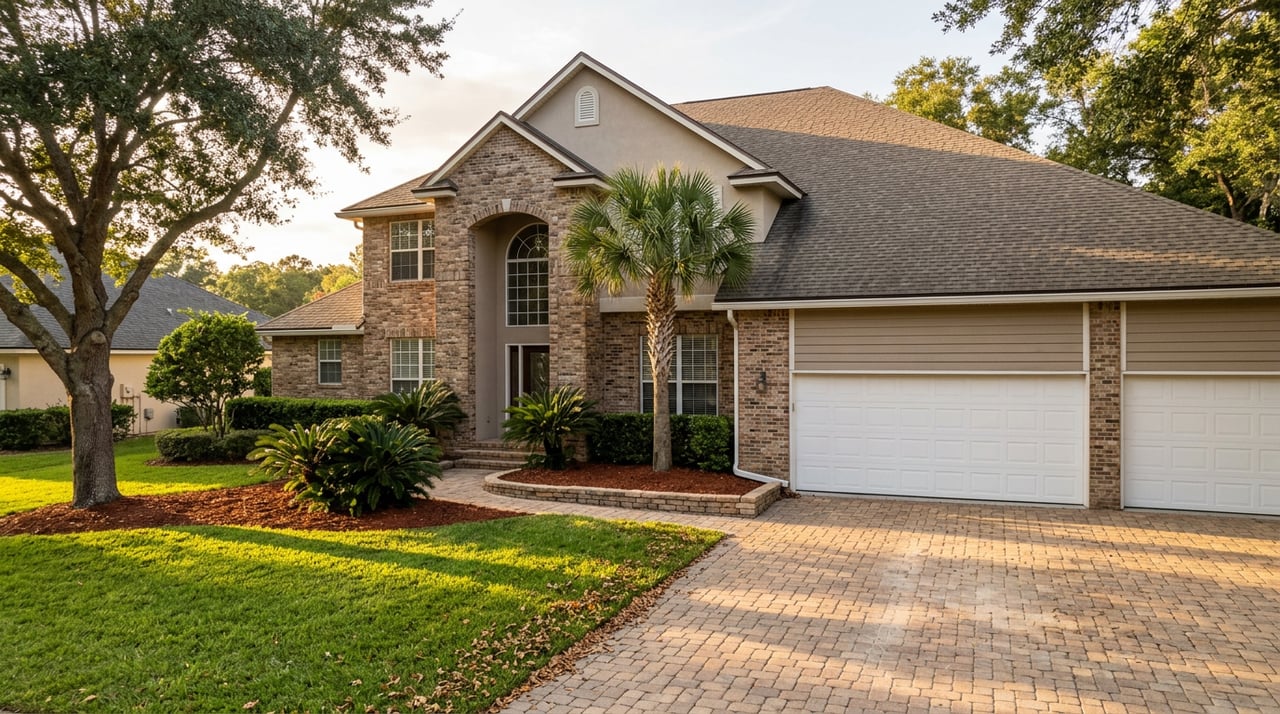
Picture two homes in Nocatee. Same floor plan, same builder, same lot width, built two years apart on the same cul-de-sac. Their list prices land within a few thousand dollars of each other. Yet one owner writes a meaningfully smaller check every year than the other, for a reason that has nothing to do with the house itself.
That gap is a Community Development District assessment, and in St. Johns County it is one of the few numbers on a listing that can change not by neighborhood, and not even by street, but by the individual parcel. If you're comparing new construction across the county's master-planned communities this fall, understanding why that gap exists matters more than the county's median price, because the median tells you almost nothing about what you, specifically, will owe every year for the next two or three decades.
The Number the Portal Doesn't Explain
As of mid-September 2026, the median list price across St. Johns County sits around $624,900, spread across roughly 1,900 active listings and averaging in the neighborhood of $334 a square foot, with recent closed sales landing at a median of $570,000. That figure gets repeated in every market report this season and it's accurate as far as it goes. What it leaves out is the second bill that shows up separately on the property tax statement for a large share of the county's newer inventory: the CDD.
A Community Development District is a special-purpose local government, created under Chapter 190 of the Florida Statutes, that lets a developer finance a community's roads, drainage, and amenities up front by issuing bonds, then repay those bonds over time through an annual assessment. The assessment has two parts. One covers debt service, the actual bond payment. The other covers operations and maintenance, the yearly cost of running the amenity centers, ponds, and landscaping. Debt service follows a fixed schedule. The Tolomato CDD's FY2027 assessment lookup lists one Nocatee bond series, for example, with a final payment date of November 2039, meaning a buyer today could be inheriting well over a decade of remaining payments on that parcel alone. O&M, by contrast, is reset annually by the district's board and can move up or down.
Here's the part that catches buyers off guard. Because the bond is attached to the parcel and not the person, an owner can prepay it early. When they do, every future owner of that specific lot inherits a lower bill, paying O&M only. When they don't, the next buyer inherits the remaining bond payments, no matter what the neighbor two doors down is paying. Two homes built from the same plan on the same street can carry different total assessments for the rest of the bond's life, depending entirely on what a previous owner decided to do with a check they wrote years earlier.
These communities use different CDD districts:
| Community | CDD District |
|---|---|
| Nocatee, St. Johns County side | Tolomato CDD |
| Nocatee, bond already prepaid | Tolomato CDD |
| Beachwalk | Beachwalk CDD |
| RiverTown | Rivers Edge CDD III |
| Shearwater | Trout Creek CDD |
| Aberdeen | Aberdeen CDD |
Confirm the exact figure and the bond's remaining term for any specific lot before you write an offer.
The Fee That Never Makes the Table
Beachwalk complicates the math further. According to the Beachwalk Club's 2026 homeowner membership packet, every homeowner there is required to join, a separate obligation from the CDD or the HOA, built around the community's 14-acre Crystal Lagoon. As of 2026, standard membership carries a one-time initiation fee of $5,000 and monthly dues of $315. Townhome owners get a modest break, at $3,750 up front and $201.60 a month. Over a ten-year hold, that membership alone adds roughly $40,000 on top of whatever the CDD line item happens to be. None of it shows up in the list price, and none of it shows up in a basic CDD comparison, because it's neither a CDD nor an HOA. It's its own mandatory obligation, easy to miss if you're pricing a Beachwalk home against its sticker alone.
The lesson generalizes past Beachwalk. Every master-planned community in the county has its own bundle of add-ons, some mandatory and some not, and comparing sticker prices across communities without adding up the full recurring obligation means comparing two different products as if they were the same one.
What Changed in March
New construction has picked up a second cost layer this year that resale homes have not. On December 2, 2025, the St. Johns County Board of County Commissioners voted unanimously to update the county's impact fee ordinance, adding a new Conservation and Open Space Impact Fee and raising existing impact fee categories toward the maximum increase Florida statute allows. The updated schedule took effect March 4, 2026, which means it has now applied to new residential permits for roughly six months.
The conservation fee funds land purchases meant to keep pace with development, in a county where more than 30 percent of land is already protected. According to Action News Jax, Mike Roberson, the county's Director of Growth Management, said the fee applies to any residential or hotel-motel development, whether that's a single custom home or a large subdivision. News4Jax reported that Commissioner Krista Joseph said it was about time developers started footing the bill for their impact on the community. Action News Jax also reported that St. Johns Riverkeeper Lisa Rinaman called land conservation one of the county's highest priorities.
The fee isn't landing all at once. It phases in at 50 percent of the full recommended amount in year one, then climbs by 12.5 percent annually until it reaches the full figure four years out. County officials estimate it will generate roughly $3 million a year once fully phased in. The ordinance also built in relief for affordable housing, waiving the fee entirely for developments serving households at or below half the area median income and cutting it in half for those between 50 and 80 percent.
For a buyer comparing a new-construction Nocatee home to an otherwise similar resale in an older section of the county, this is worth sitting with. The resale home was permitted years ago and never touched this fee. The new build was, or soon will be, and the fee only grows from here as it climbs toward full value over the next several years. That's not a reason to avoid new construction. It's a reason to ask a builder or listing agent whether the fee is already baked into the price you're being quoted, since it lands differently depending on when the permit was pulled.
Reading a Listing Like Someone Who Knows the Districts
None of this shows up cleanly on a portal listing, which is exactly the point. Before writing an offer on anything with a CDD attached, ask for:
- The district's name and number
- The current annual assessment, split between debt service and O&M
- The bond's maturity date
- Whether this specific parcel's bond has already been prepaid
All four sit in public district records, but they take a few extra minutes to pull, and they're the difference between comparing two homes on price alone and comparing what you'll actually carry month to month.
If you're weighing new construction against an older section of the county and you're still sitting on a current home, that same all-in thinking applies to selling. Knowing what your existing home is worth in today's market gives you a real number to plan against before you take on a new set of assessments.
Common Questions
Is a CDD the same as an HOA? No. An HOA is a private association that enforces community rules and covers day-to-day upkeep like landscaping and common-area maintenance. A CDD is a public special district created under state law, and its assessment funds the infrastructure and major amenities that were built up front, along with the bonds that paid for them.
Can a CDD bond be paid off early? Yes. Homeowners can typically prepay the debt-service portion of a CDD assessment, which permanently lowers the annual bill on that specific parcel going forward. The maintenance portion continues regardless, since it funds ongoing operations rather than debt.
Are there St. Johns County communities with no CDD at all? Some are, generally a mix of older, already-built-out neighborhoods and a handful of newer communities where the developer chose a different financing structure. Whether a specific community carries a CDD, and how much of the bond remains, is always worth confirming parcel by parcel rather than assuming based on the neighborhood's reputation.
Buying in St. Johns County means comparing more than square footage and school zones. It means comparing what a home will actually cost you to hold, year over year, long after closing day. RiverPoint Real Estate has spent decades working these communities from Nocatee to Aberdeen and can walk you through the CDD, the club dues, and the fee schedule for any address you're considering, so the number you plan around is the real one. If you're weighing a move here and still have a current home to sell first, ask about our Get Your Free Home Valuation tool to see where you stand before you compare it against a CDD-heavy new build.
This article is general information, not legal, tax or financial advice. Consult a qualified professional about your situation.